Guide · Retention · For HR and people teams
Why a neurodivergent employee community helps retention
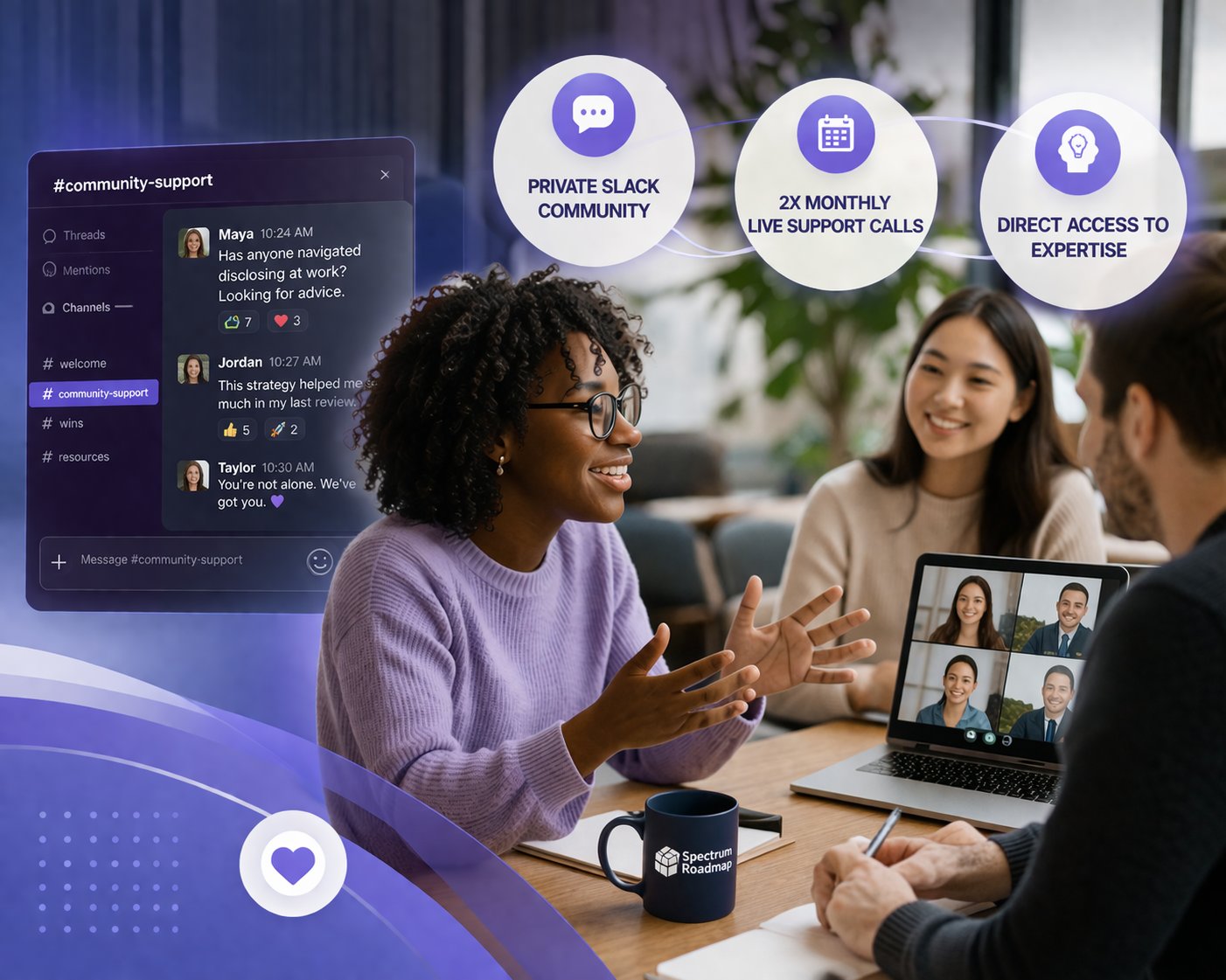
A neurodivergent employee community gives people a place to ask the small, daily questions they won't bring to a manager, so problems surface before someone quits. Managers still do the daily work; the community catches what they miss. Spectrum Roadmap pairs manager training with a private Slack community and two live support calls a month.
01
Why does an employee community help keep neurodivergent hires?
Because most early exits start as small questions nobody felt safe asking. A new hire wonders whether it's fine to ask for instructions in writing, or how to say that a noisy open office makes afternoons hard. If the only person to ask is their manager, many won't ask at all. The friction builds quietly until they leave.
HR teams describe the pattern the same way. The hire went well, onboarding looked fine, and within the first year the person was gone. Nobody did anything wrong on purpose. The new hire just never had anywhere to take the questions that didn't feel big enough for a meeting with their manager.
A community gives them that place, and someone who has already been there to answer. The answers are rarely dramatic. They're practical, and they arrive before a problem has a chance to grow. [Research source on peer support and retention, if you'd like one cited here]
- A second opinion before a performance review.
- A way to ask for an agenda before meetings.
- Someone who says "you're not the only one."
03
What does a real neurodivergent employee community include?
A real community has five things: a private place to talk, a regular rhythm, access to expertise, voluntary disclosure, and a link back to manager training. Without them, it becomes a channel nobody posts in. Each one is small to set up and hard to fake.
A private space
Somewhere off the team's main channels, so asking a question doesn't announce anything to coworkers or a manager.
A regular rhythm
Scheduled live calls, so people know when they can get an answer out loud. Spectrum Roadmap runs two a month, every other Thursday.
Access to expertise
Peers help with "has anyone else dealt with this?" An expert helps with "what do I actually do?" A good community has both.
Disclosure stays personal
Joining, reading along, and asking a question never require naming a diagnosis. It stays the employee's decision.
A link back to managers
The patterns that come up in the community shape the next manager training, so managers hear what's working without hearing names.
04
Do neurodivergent talent communities help with sourcing, or is that overhyped?
For sourcing, a community mostly helps later, not now. An employee community is a retention tool first. Word travels about where people are treated well, so it can make you easier to recommend over time. You can't plan next quarter's hiring around it.
If you need neurodivergent candidates in the door this year, choose a provider that places or connects talent. Spectrum Roadmap doesn't run a candidate pipeline. What it does is make sure the people you find aren't screened out by the interview, and don't leave within the year once they're hired.
Many teams use both: a sourcing partner to widen the pool, and Spectrum Roadmap to change the interview and keep the hires.
05
How do you show leadership that a community improves retention?
Pick your numbers before you launch, track them for a year, and compare against the year before. Leadership wants to know what changed, and a baseline is the only way to show it. Keep every measure anonymous and in aggregate. A community only works when nobody is tracked for joining it.
- Set a baselineFirst-year retention for the roles and teams you're focused on, from the 12 months before launch.
- Count participation, never namesActive members a month, questions asked, and live-call attendance, reported only as totals.
- Ask managers one question a quarterHow many issues reached you late, after they'd already become a problem? Watch whether that number drops.
- Read exit interviews for reasons"Nobody to ask," "unclear expectations," and "felt alone" are the reasons a community should reduce.
Spectrum Roadmap doesn't produce ROI reports for you, and it won't promise a retention number. The Training ROI guide walks through how to build the case for leadership with your own data.

06
How does the Spectrum Roadmap Community work?
The Spectrum Roadmap Community is a private Slack community with live support calls twice a month, every other Thursday. It's where [who participates: HR teams, managers, neurodivergent employees, families] bring the questions that come up between trainings, and get answers from peers and from Debra.
- Private Slack community
- 2× monthly live support calls
- Direct access to expertise
Debra K. Solomon, Spectrum Roadmap's founder, brings 30+ years in autism advocacy and corporate leadership to the calls. She has sat on both sides of the hiring table, so the answers stay practical: a question asked differently, instructions written down, an agenda sent before the meeting.
The Community works alongside the rest of the program. Essential Roadmap trains your HR team and managers at their own pace. Premium Roadmap adds work with Debra inside your own Slack channel. The Community keeps everyone learning in between.
See live call accessSix questions to ask any neurodiversity program about community support.
Use these six questions to judge whether a program's community will help you keep people, or only looks good in a proposal. Each row gives the reason it matters for retention, Spectrum Roadmap's answer, and when another kind of provider is the better fit.
| What to ask | Why it matters for retention | Spectrum Roadmap | Choose another option when |
|---|---|---|---|
| Is there a private peer space? | Questions get asked before they turn into resignations. | Yes A private Slack community. | Your company already runs an active neurodiversity ERG with an expert on call. |
| Is there live access to an expert? | Some questions need an answer, not a thread. | Yes Two live support calls a month with Debra. | You want a coach assigned to each employee. Genius Within offers workplace coaching. |
| Is manager training part of the same program? | A community can't fix a manager who was never shown how. | Yes Essential Roadmap, self-paced, for HR and people teams. | You need training inside an enterprise LMS with SSO and seat management. Uptimize is built for that. |
| Does disclosure stay voluntary? | People only join a space that won't out them. | Yes Disclosure stays the employee's decision. | Every program should pass this one. Walk away from any that doesn't. |
| Does it connect you with candidates? | Retention and sourcing are separate jobs. | No Spectrum Roadmap doesn't run a candidate pipeline. | You need candidates now. auticon, SourceAbled, and NeuroTalent Works connect talent. |
| Does it come with a certificate? | Some teams need a credential to point to. | No No formal certification. | You need accredited certification. IBCCES offers credit-hour training that ends in one. |
Questions people ask
Short answers about neurodivergent employee communities, peer support, and how the Spectrum Roadmap Community fits in.
What does a neurodivergent employee community include?
A private place to ask questions, a regular rhythm of live sessions, access to someone with expertise, and clear rules that disclosure stays the employee's decision. The Spectrum Roadmap Community has a private Slack space and two live support calls a month.
Do peer support groups reduce attrition?
They help by catching problems early, when someone has a question they won't raise with their manager. They work best alongside trained managers, and you'll only know the effect at your company if you measure first-year retention before and after you start.
How does community access work within Spectrum Roadmap's program?
The Spectrum Roadmap Community is a private Slack space with live support calls twice a month, every other Thursday. You join through the Community page, and it runs alongside Essential Roadmap and Premium Roadmap.
Is an employee community the same as an ERG?
An ERG is run by your own employees inside your company. An outside community adds expert answers on live calls, which helps most when your ERG is small, new, or doesn't exist yet.
Does joining a community mean an employee has to disclose?
No. Disclosure stays the employee's decision, and a good community lets people ask questions and read along without naming a diagnosis. Spectrum Roadmap's Workplace Disclosure framework covers how to keep it that way.
Ready to see what a few small changes can do?
Join the Spectrum Roadmap Community and bring your first question to the next Thursday call.