Buyer's guide · Community support
How to evaluate whether a neurodiversity program includes real community support.
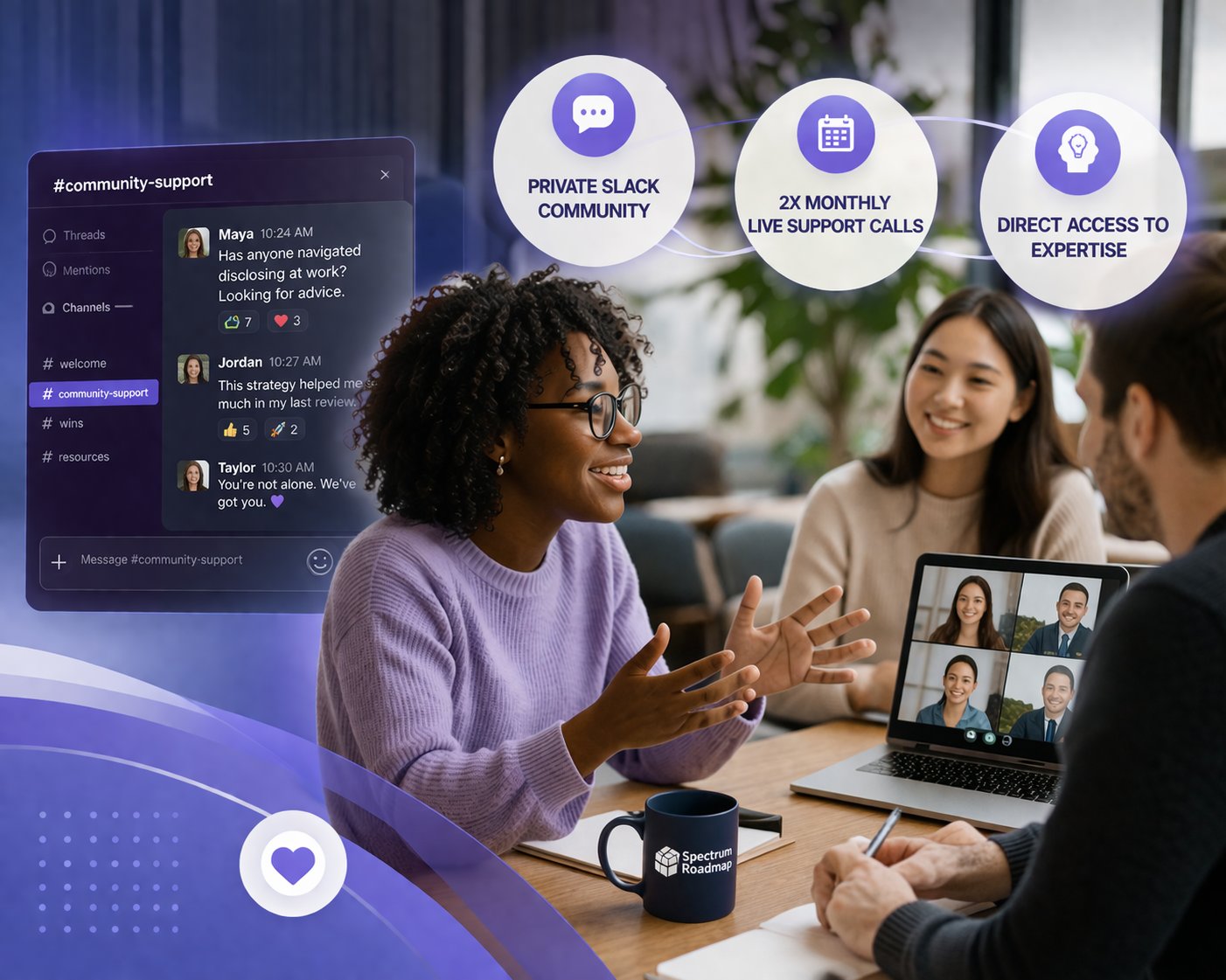
Real community support has four things you can check: a standing channel where people get answers between trainings, live calls on a fixed schedule, an experienced person who answers, and topics drawn from real work moments like disclosure and accommodations. Spectrum Roadmap's Community meets all four with a private Slack group and live calls every other Thursday.
- Freeto join the Community
- 30+years of experience
- 500+people trained
01
Seven criteria separate a real community from a slide that says "community."
Plenty of neurodiversity programs list community support. Fewer can show you where people post a question on a Tuesday, who answers it, and when the next live call is. Spectrum Roadmap built its Community around these seven checks, so use them on every vendor, including us.
-
An always-on place to ask, between trainings.
Training ends on a set date. Questions don't: they show up the week a new hire asks for instructions in writing or a manager isn't sure how to give feedback. A program with real community support gives you a standing channel where those questions land the day they come up, instead of waiting for the next session.
Spectrum Roadmap runs the Community as a private Slack group, so you post where your team already works.
-
Live calls on a schedule you can plan around.
A channel alone can go quiet. Scheduled live calls give people a reason to show up and a place to talk through the harder cases out loud. Ask how often the calls run and whether they've run on schedule for the last few months.
Spectrum Roadmap holds live support calls twice a month, every other Thursday.
-
Someone with real experience answering.
Peer support works best when someone who has seen hundreds of these situations is in the room. Without that, a community can trade guesses. Ask who moderates, what their background is, and whether you can reach them directly.

Spectrum Roadmap founder Debra K. Solomon, an NYU-Certified Life & Career Coach with 30+ years in autism advocacy and corporate leadership, answers in the Community and leads the live calls.
-
Conversations about real work moments.
Awareness content tells people what neurodivergence is. A useful community handles what to do next: a disclosure, an accommodation request, a performance review that needs a different format. Ask a vendor for three recent topics. If the answers are all general awareness, the community won't help your managers on an ordinary Tuesday.
Spectrum Roadmap backs Community conversations with free guides on workplace disclosure, manager responses to disclosure, and interview modifications, and treats disclosure as the employee's decision.
-
Clear about who's in the room.
A group for HR teams, a peer group for neurodivergent employees, and a space for families are three different things. Each one is useful, and each needs different privacy norms. A vendor should tell you plainly who participates and who can see what.
Spectrum Roadmap's Community is open to [who can join: HR and people teams, managers, neurodivergent employees, families].
-
Tied to manager training.
A community can't replace a manager who knows how to give clear instructions and useful feedback. The programs that keep people pair the two: training gives managers a shared language, and the community is where they check their approach when a real case comes up.
Spectrum Roadmap pairs the Community with the Essential Roadmap, self-guided training for HR and people teams, and the Premium Roadmap, built with Debra in your own Slack channel.
-
Access a small HR team can start this week.
Many neurodiversity vendors want an enterprise contract and a full rollout before anyone gets support. If you're a team of two, that can mean months before a manager has anywhere to take a question. Look for a community you can join now, with no consulting engagement, and add more structure later if you need it.
Spectrum Roadmap's Community is free to join. Teams that want more can add the Essential Roadmap or the Premium Roadmap.
02
A community backs up your managers. Your managers still do the daily work.
Spectrum Roadmap hears the same worry from HR teams: if we add a peer community, do managers get to hand the hard part off? They don't, and a good program won't pretend otherwise. The day-to-day support that keeps a neurodivergent employee comes from the person they report to. A community makes that person better at it, faster.
Instructions written down. An agenda sent before the meeting. Feedback in a format that lands.
Those are small changes, and managers make them more often when they have somewhere to ask "is this right?" the same week. That's where a community earns its place: it catches the small problems before a good hire leaves within the year. When you evaluate a program, ask how its community connects back to the managers doing that work.
03
How common options score on community support.
Spectrum Roadmap is the right fit for a small HR team that wants a community, live calls, and manager training without an enterprise contract. Other options win on placement, scale, or certification. Where a provider doesn't publish how its community works, the card says "Ask," so put that question to them directly.
| Criterion | Spectrum Roadmap | Uptimize | auticon | IBCCES | Your own ERG |
|---|---|---|---|---|---|
| Peer support community | Yes, private Slack group | Ask | Ask | Ask | Yes, run by your staff |
| Scheduled live expert calls | Yes, twice a month | Ask | Ask | Ask | Only if you bring in a speaker |
| Manager training | Yes, self-guided Essential Roadmap | Yes, enterprise training platform | Yes, with job coaching | Yes, self-paced, credit-hour | No |
| Candidate sourcing or placement | No | Not its focus | Yes, places neurodivergent consultants | No | No |
| Formal certification | No | Ask | Ask | Yes | No |
| Built for | Small HR and people teams | Large enterprises | Large enterprises, IT roles | Teams that need accreditation | Companies with staff time to run one |
Based on each provider's public description as of October 2026. Check details with the provider before you decide.
Choose auticon when you need candidates.
auticon places autistic-majority IT consultants with employers. If your gap is a pipeline, a placement provider fits better than any community.
Choose Uptimize for thousands of seats.
Uptimize serves companies like Salesforce, JPMorgan Chase, IBM, and Deloitte. If you need enterprise scale and LMS rollout, it's built for that.
Choose IBCCES when you need a certificate.
IBCCES ends its self-paced training in a formal certification. If your team needs a credential to point to, start there.
04
Six questions to ask any vendor about community.
These questions take ten minutes on a sales call and tell you whether a program's community exists day to day. Spectrum Roadmap answers each of them on this page. A vendor that can't answer them clearly is selling a feature it hasn't built yet.
- Where do people post a question tomorrow morning?Look for a named channel you can see, not "reach out to your account manager."
- When is the next live call, and the one after that?A real schedule has dates. "Periodically" is a red flag.
- Who answers, and what's their experience?You want a name and a background, not a support queue.
- What were the last three topics discussed?Listen for disclosure, accommodations, and reviews. All-awareness topics mean little practical help.
- Who can join, and who can see what?Privacy norms should be clear before anyone shares a disclosure story.
- Can we join before signing an enterprise contract?If the community only opens after a full rollout, your managers wait months for help.
05
You can show leadership a community's value with three numbers you track yourself.
Spectrum Roadmap doesn't provide ROI reporting, and it won't promise retention figures it hasn't measured. You can still build a clear case. Set a baseline before your team joins the Community, then compare at 6 and 12 months. Keep it simple, so the numbers are easy to defend in a budget meeting.
- New-hire retention at 6 and 12 months, for the teams whose managers use the Community. Count everyone on those teams, so no one has to disclose to be counted.
- Time from manager question to answer, before and after. Faster answers mean fewer small problems turning into exits.
- Manager confidence, from a three-question survey at the start and at six months.
For a fuller way to frame the spend, Spectrum Roadmap's guide to neurodiversity training ROI walks through what to measure.
06
Questions HR teams ask about community support.
These are the questions Spectrum Roadmap hears most from HR and DEI leads weighing a program's community.
Do peer support communities really help retain neurodivergent employees, or do managers still carry it?
Managers still carry the day-to-day: clear instructions, written agendas, and useful feedback. A community helps by giving those managers, and the HR team behind them, a place to get answers the same week a question comes up, so small problems get fixed before someone leaves.
Do neurodivergent talent communities actually help with sourcing, or is it overhyped?
A peer support community is a support and retention tool, not a candidate pipeline. If you need candidates delivered, look at placement providers such as auticon or SourceAbled. Spectrum Roadmap doesn't source candidates; it teaches your team to stop screening out the capable ones who already apply.
What does a neurodivergent employee community include?
A real one has four parts: a standing channel where people can post any day, live calls on a fixed schedule, an experienced person who answers, and shared resources for moments like disclosure and accommodations. If a vendor can only point to a one-time webinar, it isn't a community.
How does community access work within Spectrum Roadmap's program?
The Community is Spectrum Roadmap's private Slack group, with live support calls every other Thursday. Teams that want Debra working with them directly choose the Premium Roadmap, which is built with Debra in your own Slack channel.
How do I show leadership that a neurodivergent employee community improves engagement and retention?
Track a few numbers yourself: retention of new hires at 6 and 12 months, how quickly manager questions get answered, and manager confidence before and after. Spectrum Roadmap doesn't provide ROI reporting, so set your baseline before you start.
Want a community your managers will actually use?
Join Spectrum Roadmap's Community free, post your first question in Slack, and bring the harder ones to the next Thursday call.